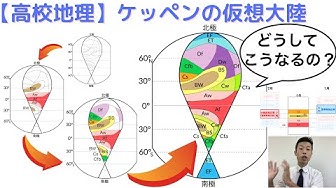
【高校地理】3-6. ケッペンの気候区分 | 3. 世界の気候
The sixth episode of our high school geography lesson video series, "Climates of the World," is about the Köppen Climate Classification. In this video, we'll explain what a climate classification is and how to determine a Köppen climate classification, and then practice determining a climate classification. [Table of Contents] 0:00 Introduction 0:18 What is a climate classification? 1:33 Distribution of Climate Classifications 2:43 Procedure for Determining the Köppen Climate Classification 9:14 Climate Classification Practice [Review Questions] https://forms.gle/G7k1v3v1hRmFpb2W6 [Click here to review this video's contents with text and images] https://www.geography-lesson.com/kopp... [See the video table of contents on this website] https://www.geography-lesson.com/ #geography #climate #KöppenClimateClassification #GeographyB #Köppen Climate classification is a method of dividing the various climates found around the world into several groups. Of the various methods of grouping, the most widely used is that devised by German geographer Köppen. As an aside, Köppen was also Wegener's father-in-law, who was featured in the "continental drift theory" in the field of geography. During his travels around the world, Köppen noticed that even in places far apart, similar climates lead to similar vegetation. "Vegetation" refers to the group of plants that grow in a certain area. For example, in places with hot climates and abundant rainfall all year round, the same vegetation known as "tropical rainforests" can be found in both Africa and Southeast Asia. Köppen therefore classified the world's climates into five major categories: A, B, C, D, and E, based on the climatic factors of "temperature" and "precipitation," which have the greatest impact on vegetation. The letters A through E stand for: Tropical, hot places; arid, dry places; temperate, warm places; cool, cold places; polar, and very cold places. They are distributed in this order, A, B, C, D, and E, as the latitude increases from the equator. Let's take a look at a rough distribution on a world map. Tropical A climates are found at the lowest latitudes, near the equator, where it is hot all year round. Tropical rainforests are found in areas with heavy rainfall, while savannas are found in places with distinct rainy and dry seasons. The dry B climate is found at slightly higher latitudes than A climate, such as the Sahara Desert, the Arabian Peninsula, southern Africa, and Australia. Precipitation is low and trees are not found. Going even higher from B climate, we reach the temperate C climate, which is neither too hot nor too cold, like Japan and Europe. Going even higher latitudes, such as Russia and Canada, we enter the cold, polar D climate. This is the temperature where trees can just about grow, but only a limited number of tree species can thrive in this cold, so vast areas are made up of cold-hardy coniferous forests. Incidentally, the latitudes corresponding to Russia and Canada are oceans in the Southern Hemisphere, so D climate only exists in the Northern Hemisphere. Furthermore, near the Arctic and Antarctic lies the extremely cold polar E climate. Now that we have a general idea of the global climate, let's take a closer look at the detailed process for determining the Köppen climate classification. 2. Köppen Climate Classification Köppen climate classification is divided into two major categories based on the presence or absence of trees. If there are trees, it's classified as A, C, or D. If there are no trees, it's classified as B or E. The reasons why trees do not grow can be divided into two: areas with too little rain, i.e., dryness, are called arid B climates; areas with too low temperatures, i.e., cold temperatures, are called polar E climates. B climates are further divided into two based on precipitation. A climate with a little rain, where trees do not grow, but where grass can grow and the grass is covered with vast grasslands, is called a BS climate, or steppe climate. It's similar to a Mongolia-like landscape. A climate with no rain at all, where trees, let alone grass, can hardly grow, is called a BW climate, or desert climate. When we say desert, we don't just mean sandy deserts; many areas are covered with rocks. The minimum amount of precipitation necessary for tree growth is called the "drying limit." If the annual precipitation is below the dry limit or more than half the dry limit, the climate is called a BS climate. If the precipitation is less than half the dry limit, the climate is called a BW climate. There is a formula for determining this dry limit, but high school geography classes rarely involve calculating it, so it's sufficient to think of it as a BS climate if the annual precipitation is roughly 500mm or less, and a BW climate if it's half that, roughly 250mm or less. Next is the polar E climate. A climate that is too cold for trees to grow is defined as one ...

![[High School Geography] 3-7. Nature and Life in Climate A (Tropical) (Rainforests, Savannas, Lato...](https://i.ytimg.com/vi/k3O45bKSd-I/hqdefault.jpg?sqp=-oaymwEjCNACELwBSFryq4qpAxUIARUAAAAAGAElAADIQj0AgKJDeAE=&rs=AOn4CLCiGQYTx8Jyz1XkrJ6ZATPikxkgiQ)
[High School Geography] 3-7. Nature and Life in Climate A (Tropical) (Rainforests, Savannas, Lato...
![[High School Geography] 3-2. General Atmospheric Circulation (How Rainy and Dry Seasons Occur) | ...](https://i.ytimg.com/vi/ALGn7mNynZo/hqdefault.jpg?sqp=-oaymwEjCNACELwBSFryq4qpAxUIARUAAAAAGAElAADIQj0AgKJDeAE=&rs=AOn4CLBfLIgjlQUUe01DqOzNHjtn_ns3Wg)
[High School Geography] 3-2. General Atmospheric Circulation (How Rainy and Dry Seasons Occur) | ...

【ケッペンの気候区分】アルファベットの意味を知って特徴を理解!分類の仕方から乾燥限界まで解説【高校地理】

【共通テスト】たった1本でアジア地誌を全解説【地理総合・地理探究】

First Japanese Winner of "World's Top Scientist": Meet the Super High Schooler Whose Complex Rese...

【高校地理】3-9. C気候(温帯)の自然と暮らし | 3. 世界の気候

How many points can you get on the Test Geography B with only 10 hours of study from no study?

Something is jamming GPS over Europe. Here's what we found

Why Filipino Women Are Choosing to Stay Single Forever | AB Explained
![[High School Geography] 3-4. Ocean Currents and Climate (Coastal Deserts, El Niño Phenomenon, etc...](https://i.ytimg.com/vi/ruiYQLt8mtg/hqdefault.jpg?sqp=-oaymwEjCNACELwBSFryq4qpAxUIARUAAAAAGAElAADIQj0AgKJDeAE=&rs=AOn4CLALW8SQEuQmZTtPZsJ1QzEFBWierg)
[High School Geography] 3-4. Ocean Currents and Climate (Coastal Deserts, El Niño Phenomenon, etc...

3-HOUR STUDY WITH ME | Hyper Efficient, Doctor, Focus Music, Pomodoro 50-10

【高校地理】3-8. B気候(乾燥帯)の自然と暮らし(ステップ気候、砂漠気候) | 3. 世界の気候
![[High School Geography] 2-7. Small landforms created by rivers (fans, floodplains, deltas) | 2. T...](https://i.ytimg.com/vi/adk31rzqE1E/hqdefault.jpg?sqp=-oaymwEjCNACELwBSFryq4qpAxUIARUAAAAAGAElAADIQj0AgKJDeAE=&rs=AOn4CLAHHR7jD0UjeXtIRzTak6YUviH9eQ)
[High School Geography] 2-7. Small landforms created by rivers (fans, floodplains, deltas) | 2. T...

The dark side of AI - Exploitation of humans and nature | DW Documentary
![[High School Geography] 3-1. Climate Elements and Factors, Global Temperatures | 3. Global Climate](https://i.ytimg.com/vi/cWD7qcq0NNc/hqdefault.jpg?sqp=-oaymwEjCNACELwBSFryq4qpAxUIARUAAAAAGAElAADIQj0AgKJDeAE=&rs=AOn4CLBLfiPA5aXLPDFYLOKVfiXkMuwD9A)
[High School Geography] 3-1. Climate Elements and Factors, Global Temperatures | 3. Global Climate

【高校地理】2-10. 氷河地形、カルスト地形、サンゴ礁 | 2. 世界の地形

【漢文15分で満点の思考法!!】手元公開!共通テスト漢文の対策!!

【高校地理】2-9. 海岸の小地形(リアス海岸、フィヨルドなど) | 2. 世界の地形
![[High School Geography] 3-12. Vegetation and Soil | 3. Climates of the World](https://i.ytimg.com/vi/BaIe31F-MKU/hqdefault.jpg?sqp=-oaymwEjCNACELwBSFryq4qpAxUIARUAAAAAGAElAADIQj0AgKJDeAE=&rs=AOn4CLDUILHwcPuEh69jKMqjSvYnea9QtA)
[High School Geography] 3-12. Vegetation and Soil | 3. Climates of the World