TOUT savoir sur les amplificateurs audio !
• Follow us every week on our Facebook page: / incroyablesexperiences • You can support us on Tipeee: https://www.tipeee.com/incroyables-ex... • Building an amplifier: Audio amplifiers are everywhere. They're found in concert halls, hi-fi systems, and even Bluetooth speakers. They're responsible for the pleasure of body-shaking bass, as well as the high-pitched sounds that are so pleasant to listen to... But do you know how an amplifier works? What components transform a tiny signal into a powerful electrical current capable of powering large speakers? This comprehensive video explains the characteristics of an amplifier and the different types of speakers. You'll then discover the precise operation of class A, B, and even D amplifiers. This information will help you understand the logic of electronics and build your own amplifiers! • Excerpts: By the way, how does a loudspeaker work? It's like an electric motor that operates back and forth. They consist of a coil connected to a membrane and a magnet. When an electric current flows through the coil, it becomes more or less magnetic and is sometimes attracted by the magnet, sometimes repelled. Ideally, the movement of the coil and therefore that of the membrane reproduce the variations in the signal identically. By moving through the air, the membrane creates pressure waves of varying strength, in other words, sound. Loudspeakers are everywhere; they're found in speakers, phones, computers, headphones, earbuds, and many other devices of all sizes. A loudspeaker alone performs poorly; it struggles to transmit all its power to the air, and then there's an acoustic short circuit. To put it simply, the waves they produce in front of or behind them are opposite and cancel each other out. To remedy this, you can install a baffle, a plate that separates the two sides to isolate them. In this case, the sound power is much greater, but the baffle must be very large; it's not really practical! Fortunately, there are different speaker technologies that allow for space savings. The simplest is the sealed enclosure. The internal wave is trapped, so only the external wave is heard. The most common technology is the bass-reflex enclosure, which has a vent. The sound exits the vent with a slight delay, which allows the previous wave to be added to the new one coming out of the speaker—a way to increase the sound power without consuming more energy. Returning to amplifiers, they can easily be characterized by two parameters. The first is gain. An amplifier with a gain of 10 multiplies the amplitude of the input signal by 10. You give it more or less 2V as an input, and it outputs more or less 20V. Obviously, all this is true as long as the output amplitude doesn't exceed a maximum value. If you give this amp a 3V signal and it's powered by 20V, it obviously won't be able to output 30V. The output signal will be clipped at the top and bottom, and it does something like this... it's called saturation. The second parameter that characterizes an amp is its internal resistance, also called output impedance. The lower it is, the more the amp will be able to deliver a high output current. All this without significant voltage drop or overheating. So how does a Class D amp work? To understand what's so special about it, we first need to understand why Class A and B amps have such poor efficiency. If we try to create an alternating voltage, much like music, from a direct voltage, we realize that a good portion of the energy must be lost as heat. This heat appears in the transistors, which are never completely on or off. We would therefore need to find a system in which the transistors operate only in an on-off mode, like a switch. • Other titles: Make a powerful amplifier / Make a speaker amplifier / DIY music amplifier / How an amplifier works / Homemade speaker / Speaker and baffle / Class A, B, and D amplifier / Subwoofer / Incredible idea for TPE experiment TIPE BAC S / vik95170 / French science experiment / DIY.


L'ampli op - les bases

Le rodage des haut-parleurs

La classe D est numérique... vraiment ?!? (Ep. #017)

Make ultra Bass Amplifier at home using TDA2030, Homemade Amplifier DIY

Supravox : la légende française du large bande que les audiophiles n’ont jamais oubliée

The Legendary Magnetron: How It Really Works

La percée chinoise des batteries au sodium vient de rendre le lithium obsolète !

Focal / JMlab: The Secret History of a French Hi-Fi Revolution

432Hz + 528Hz + 741Hz | The Deepest Healing Sleep: Whole Body Regeneration, Remove Insomnia Forever

Ce Sound System Audiophile est FOU !

Don't Throw Away Old DVD Player If You Don't Know This! You'll Be Shocked

CHOSEN ONE!! YOUR IDENTITY REVEAL JUST SHOOK THE INTERNET... AND THEIR MINDS

Fabriquer une enceinte bluetooth !

How to make Ultra Bass Powerful Amplifier 1000W with 10 Transistor and U741, DIY Ultra Bass

Billions of People Don't Know This Secret 😱 Turn an old washing machine motor into FREE Energy 247

The transistor: tutorial #1 - the basics - switching

Comment régler un caisson de basse ? (Ep. #009.2)

Before You Trash Your Old PC Power Supply... Build This!

CHOSEN ONE! SOMEONE IN A SUIT JUST ASKED "WHO TRAINED THEM?" ...NOBODY DID. THAT'S THE MYSTERY

At the heart of Perpignan's Sound System culture - Building a Reggae Dub Sound System
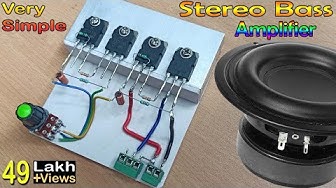
Simple & Powerful Stereo Bass Amplifier // How to Make Stereo Amplifier with D718 Transistor

Inside a 3000W Water-Cooled Power Supply (with GaN & SiC)

Operational amplifier: understanding op-amps simply (electronics course)

The 5 Most INSANE Hi-Fi Amplifiers of the 70s (These Things Are MONSTERS)

Apprendre à réparer l'électronique - Le matériel

Building a Tube Amp! Does it produce better audio quality though? EB#47

Don't WASTE your MONEY on these AUDIOPHILE TRAPS!

Lantech n ° 1: Beginners | How does a guitar amp work?

It’s a mistake to throw away old car alternator! This easy idea you’ll use every day
